
Home > Burial Insurance with Pre-Existing Conditions > Chronic Pancreatitis
Final Expense Insurance with Chronic Pancreatitis

If you live with chronic pancreatitis, you may be wondering whether a health history like yours puts final expense insurance out of reach. The short answer is that coverage is usually available — what changes is which companies will accept you, which pricing tier you land in, and how long any waiting period lasts. This page covers the real verdict for chronic pancreatitis, how carriers look at your condition and your medications, which companies tend to be most forgiving, and simple steps that can help you land the best rate.
Can you get final expense insurance with chronic pancreatitis?
Yes. In most cases, chronic pancreatitis will not keep you from getting final expense insurance. It is not one of the conditions that forces everyone into a waiting period.
What changes is which pricing tier you land in. That comes down to two things: how long you’ve been stable, and what caused your pancreatitis.
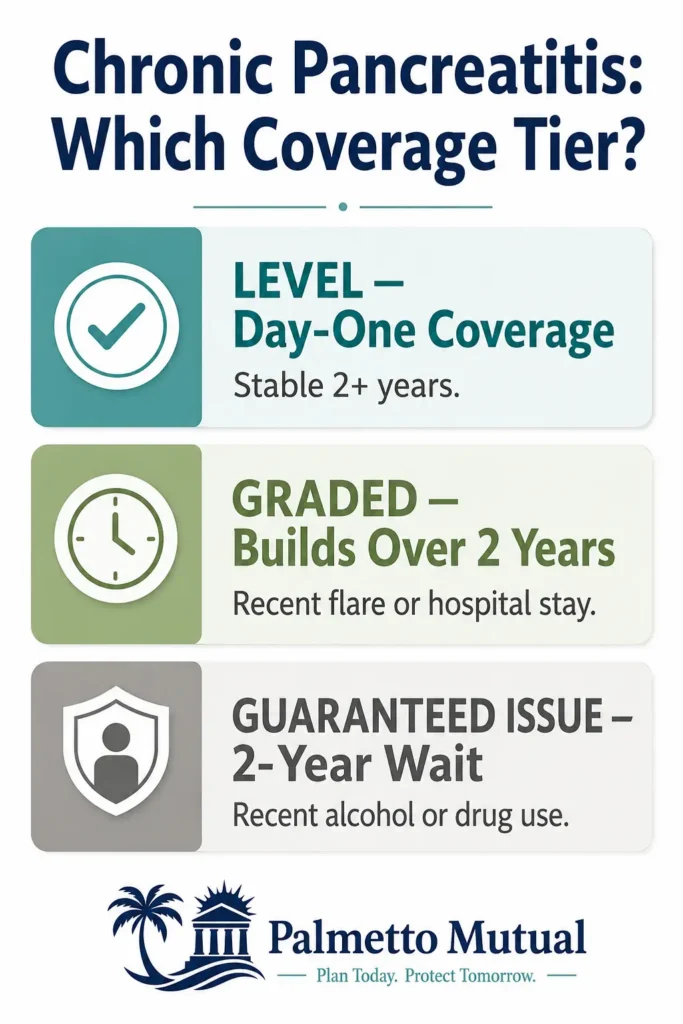
Here is the general picture:
| Your situation | What you’ll usually qualify for |
|---|---|
| Stable for about 2 years, with no recent hospital stays | Level coverage — the full benefit starts on day one |
| Diagnosed, treated, or hospitalized within roughly the last 2 years | A graded or modified plan — a partial benefit that builds to the full amount over about 2 years |
| Recent heavy alcohol or drug use, or other serious conditions on top | Guaranteed issue — full benefit after a 2-year waiting period |
Most people with settled, well-managed chronic pancreatitis fall in the top row and can get day-one coverage.
The cause matters too. Pancreatitis tied to past alcohol use is looked at more closely, and carriers will ask about your current drinking.
The bottom line: having chronic pancreatitis rarely closes the door. The label on your policy depends on timing and cause, not on the diagnosis by itself. The next section shows exactly what carriers look at.
How carriers underwrite chronic pancreatitis
Burial insurance is simplified issue. That means no medical exam and no blood work. Carriers make their decision from two things: a short list of health questions, and two quiet electronic checks — your prescription history and your Medical Information Bureau (MIB) record.
How those two checks work is covered in detail on our prescription history page. Here, we’ll focus on what carriers ask about chronic pancreatitis specifically.
Most applications name chronic pancreatitis directly, usually inside a two-year look-back window. The question reads something like: “In the past two years, have you been diagnosed or treated for chronic pancreatitis?”
A “yes” inside that window usually moves you to a graded or modified plan. A “no” — meaning you’ve been stable and outside that window — keeps day-one coverage on the table.
Two more things carriers weigh:
- A recent hospital stay. Most applications ask if you’ve been hospitalized in the past two years. A recent stay tied to your pancreatitis can trigger a waiting period on its own.
- The cause. If your pancreatitis is linked to alcohol, expect questions about your current and recent drinking. Active or recent use narrows your options.
Medications underwriters watch for with chronic pancreatitis
Your prescription history tells the underwriter how active and advanced your pancreatitis is. Different drugs send different signals. Here’s how carriers tend to read the most common ones.
| Medication type | Common examples | What it signals |
|---|---|---|
| Pancreatic enzyme replacement | Creon, Zenpep, Pancreaze, pancrelipase | Confirms ongoing chronic pancreatitis that’s being managed. A steady maintenance signal — not a red flag by itself. |
| Diabetes medication or insulin | insulin, metformin | Suggests the pancreas has lost some of its hormone function. Points to more advanced disease. |
| Strong pain medication (opioids) | oxycodone, hydrocodone, tramadol, fentanyl | Signals painful flare-ups and less-controlled disease. Often the biggest factor pushing an application toward a graded plan. |
| Fat-soluble vitamin therapy | prescription vitamin A, D, E, and K | Points to poor absorption of nutrients from long-standing disease. |
| Alcohol-use-disorder medication | naltrexone, acamprosate, disulfiram | Signals an alcohol-related cause, which carriers look at more carefully. |
Taking one of these does not mean you’ll be turned down. It simply shapes which tier and which company fit you best. Recency matters most — a drug you started years ago and take steadily reads very differently from one added after a recent flare.
Pain medication carries the most weight here. Because opioids affect more than just pancreatitis applications, we cover them in depth on our opioids and funeral insurance page.
Best companies and what you’ll pay with chronic pancreatitis
With chronic pancreatitis, the “best” company is simply the one whose questions and look-back window fit your timeline and cause. Carriers word their pancreatitis questions differently, so the same person can be offered level coverage by one company and a graded plan by another.
That is why an independent agency matters. Rather than guessing, an agent can match your profile to the carrier most likely to approve you at the best tier — before you ever apply.
Here is the part that surprises most people: chronic pancreatitis by itself does not add a surcharge to your premium. Final expense insurance is priced on your age, gender, tobacco use, and how much coverage you buy — not on the diagnosis.
The tier is what moves your price:
| Tier | How it’s priced | Coverage timing |
|---|---|---|
| Level (day-one) | Standard rates for your age, gender, tobacco status, and coverage amount — no condition surcharge | Full benefit starts immediately |
| Graded or modified | A somewhat higher rate for the same coverage | Partial benefit that builds to full over about 2 years |
| Guaranteed issue | Priced on age, gender, and coverage only; health isn’t considered — usually the highest cost | Full benefit after a 2-year wait |
For a rough sense of level-coverage pricing, here are sample non-tobacco averages for a $10,000 policy:
| Age | Sample monthly premium ($10,000, non-tobacco) |
|---|---|
| 50 | about $30–$40 |
| 65 | about $50–$65 |
| 80 | about $120–$130 |
These are ballpark averages to set expectations, not quotes. Your exact rate depends on your age, gender, tobacco status, state, and coverage amount. Full pricing broken down by coverage amount and by age lives on our cost-by-coverage and cost-by-age pages.
How to get the best rate and coverage with chronic pancreatitis
A few simple steps can move you into a better tier — or keep you out of a worse one.
Know your timeline. The biggest single factor is how long you’ve been stable. Write down your diagnosis date, your last flare, and any hospital stay. If you’re close to the two-year mark, waiting a little before applying can shift you from a graded plan to level coverage.
Have your medication list ready. Carriers review your prescription history anyway, so come prepared with an accurate list. Being able to explain what each drug is for — and that you take it steadily — works in your favor.
Know your cause. If your pancreatitis is alcohol-related, be ready to speak to your current sobriety. Time since your last drink matters to carriers.
Disclose honestly. Underwriting systems catch nearly every omission through your prescription and medical records. An honest application keeps your policy solid, so your family’s benefit can’t be challenged later.
Don’t apply scattershot. Each decline can make the next application harder, and applying with the wrong carrier first is a common, avoidable mistake. An independent agent shops your profile across carriers so your first application is with a company likely to approve you.
For exactly how waiting periods work, see our no-waiting-period page. For what leads to a decline and how to bounce back, see our can-you-be-denied page.
With the right timing and the right carrier, most people with chronic pancreatitis can get affordable burial insurance — often with no waiting period at all.
Keep Reading







About the Author
Dvir Mosche is an award-winning independent insurance agent and the founder of Palmetto Mutual, a trusted insurance brokerage specializing in Final Expense Life Insurance. Since entering the industry in 2017, he has been recognized multiple times as a top agent for his dedication to educating and assisting seniors in finding the proper coverage. His mission is to simplify the process, provide honest and personalized guidance, and ensure that every client gets coverage they can depend on for life.


